In 1909 the Northern Pacific railroad obtained several Baldwin ‘Q-3’ 4-6-2 Pacific locomotives for use on passenger lines west of the Twin Cities. Four of the series survive today. Two of them (2153 and 2156) are owned by the Minnesota Transportation Museum and stored at the Jackson Street Roundhouse in St Paul Minnesota. Neither is operational.
Northern Pacific 2153
NP 2153 was displayed in a park in East Grand Forks for a few decades. Around the year 2000, was purchased and moved to the roundhouse. It’s assembled, but in unknown mechanical condition. It spends most of its time in storage at the roundhouse.

Northern Pacific 2156
About 1980, the museum obtained NP 2156 from the City of St Paul, who had obtained it from Northern Pacific in the 1950’s and displayed it in Como Park. NP 2156 was used as a prop in the popular 1950’s & 60’s Twin Cities kids TV show Lunch with Casey, so has a bit of local history attached to it.
The museum started disassembling it with the intent of restoring it to operation. Volunteers removed the lagging, side rods and pistons before discovering that while on display, water had gotten into the steam passages and broke out a large section of steam passage in one of the cylinder castings.

The museum looked into the possibility of repairing the steam passage by welding, recasting or modifying the cylinder casting. Repair was determined to be both difficult and expensive.
Even though the locomotive could not be operated unless the steam passage was repaired, museum volunteers continued to work on the locomotive as though it would someday run again. They spent thousands of hours over a couple of decades repairing and refurbishing components, but without a realistic plan for repairing the steam passage in the cylinder casting – by far the most difficult and expensive part of the restoration.

Starting around 2000, NP 2156 was blocked up on cribbing & disassembled. The boiler was sand-blasted and ultrasound tested. Various components were sandblasted & primed. Ideas for repairing the steam passage were floated around between members, but money, time and events worked against repair attempts.
Over time the core group of volunteers working on the restoration aged out or passed away, stalling the project. As a result, NP 2156 sat on cribbing, surrounded by piles of parts and miscellaneous unrelated items and gathering dust for more than a decade. While up on cribbing, volunteers occasionally made progress on restoring the driveline. Much of the suspension and brake rigging was refurbished to near-original condition, and in 2023 the pilot truck was refurbished and reassembled. But the broken steam passage was left unaddressed.
The sad part is that even though there was no viable means of repairing or replacing the broke-out steam passage, volunteers continued to believe that with enough effort the locomotive would someday run again.

Change in Direction
The handwriting had been written on the wall for many years. The locomotive would be too expensive to repair, and most railroads no longer want steam on their tracks. Older steam locomotives like 2156 and 2153 run on plain brass bearings. Without modern Timken-style roller bearings, railroads won’t let them run on their tracks anyway. The museum doesn’t own any of its own track, so would have no place to run a restored steam locomotive.
So in the summer of 2024, the museum admitted that the locomotive would never run again – at least on in our lifetimes – and made the decision to move NP 2156 out of the roundhouse where it has been cribbed up for 22 years, gathering dust, taking up valuable space and blocking the only roundhouse track with an overhead crane.

Readying for the Move
For the last five months, a small number of us volunteers have been reassembling the driveline and spring rigging and slowly lowering the 100-ton locomotive back onto its wheels. We located needed parts, many of which had been refurbished over the years, some of which had been scattered around the roundhouse, boxcars and containers.
Some parts needed to be fitted prior to lowering, some parts fitted during the lowering process, and some will need to be fitted after lowering. For parts that needed work, rather than restoring/refurbishing them to original condition, we elected to do the minimum necessary to safely lower the locomotive back onto its wheels and move it around the roundhouse yard.
Everything we touched was heavy. Springs, driver boxes and pedestal binders weigh 300 – 600lbs, the trailing axle 6000lbs. But lifting and dragging parts around with forklifts, levers, chain hoists, jacks and the 25-ton overhead crane are part of the fun.
A major constraint was that the locomotive sat over a drop pit originally built to allow drive wheels and trucks to be lowered down and shuttled over to another track for maintenance. The drop table is gone, but the 17-foot-deep pit remains, covered by open steel grating. That meant we couldn’t get close to the locomotive with a forklift and always had to be aware of how much weight we place on the grating. If we somehow managed to break through the grate, we’d end up down in the pit.
Getting Started
The thousands of hours of work that had been done by volunteers over the last decade-plus made the work we did to lower and move the locomotive much easier. The spring rigging was completely refurbished, the front truck was already assembled, and the other major components that we needed for the assembly were usable as-is or with minor work.
We started by moving the trailing axle from where it was stored in front of the locomotive to the rear of the locomotive and sliding it under the trailing truck frame. We had to lift the rear of the locomotive about eight inches to clear the wheels and then used a combination of a forklift and overhead crane to slide the wheel/axle set endwise under the locomotive.

Springs & Driver Boxes
After the trailing axle was in place we reassembled the spring rigging and springs, then set the driver boxes on top of the drive axles and lowered the locomotive about a foot.

We used chain hoists to lift and swing the springs up onto the frame. After the springs were in place, we slid the driver boxes under the locomotive and lifted them up onto the axles, againn with with chain hoists.

Lowering the Locomotive
We used four 50-ton mechanical jacks to lower the locomotive. Two of the jacks can be mechanically powered with a 1/2″ electric drill. Two of jacks are powered by long levers and good old-fashioned muscle – often with two of us on the jack lever.
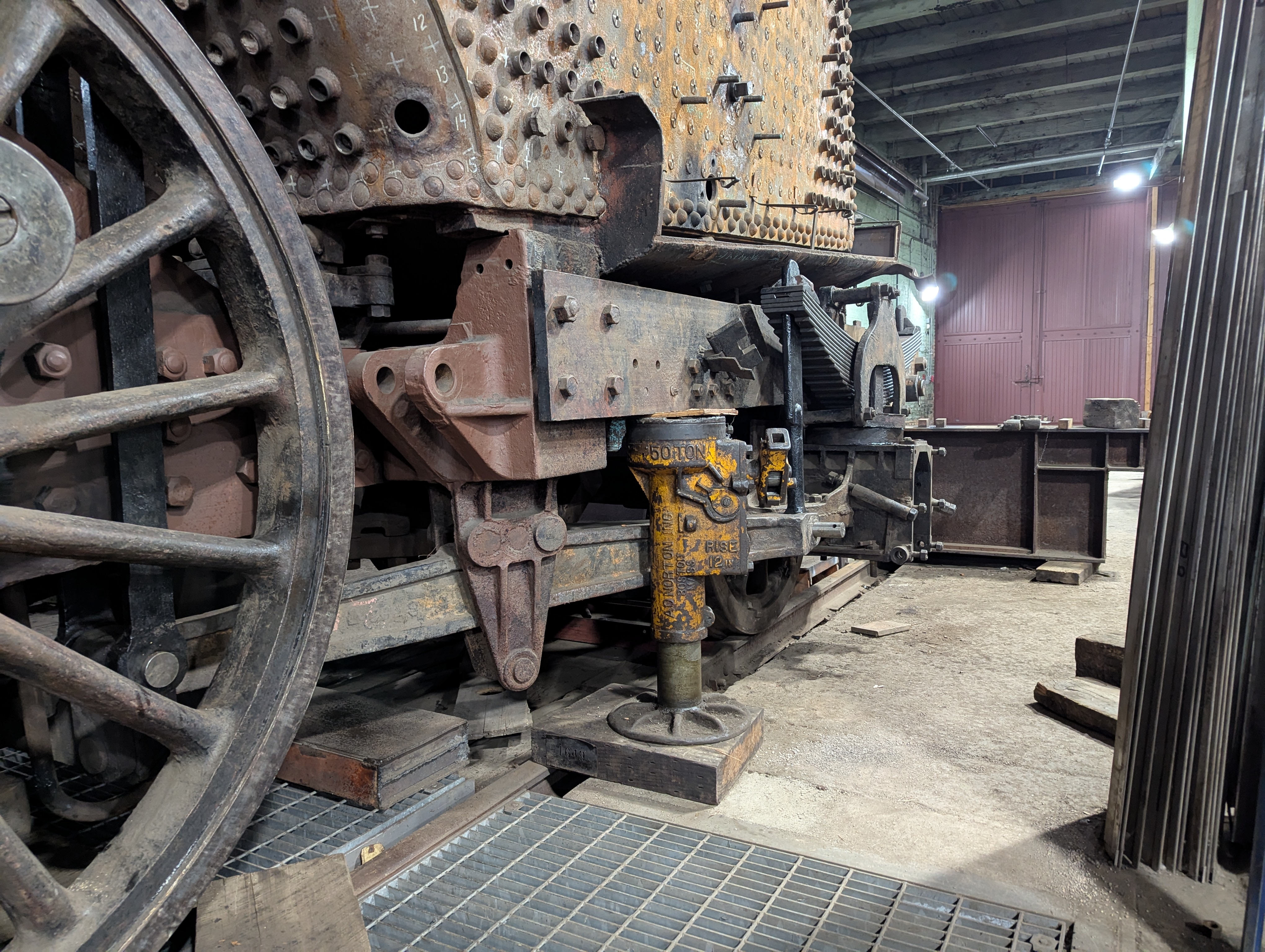
Each ‘lift’ involved wrestling the 400lb jacks into place and up onto cribbing; using the jacks to lift one end of the locomotive enough to clear the crushed part of the cribbing; removing the topmost cribbing, then lowing that end down onto the remaining cribbing. We kept it upright by referencing a laser level and never leaving more than a half inch of air between the locomotive and the cribbing.
We worked slowly – a few inches at a time.

To remove the cribbing and roll the front truck in place, we jacked up the locomotive and re-cribbed it under the cylinders. Then one afternoon, with lots of muscle, a forklift and overhead crane, a handful of us volunteers pulled out the ties and rolled the front truck under the locomotive.

The rear of the locomotive was resting on a steel beam set on railroad ties. We jacked up the rear long enough to pull out the beam using the overhead crane, then lowered the rear the last few inches.

As of December 2024, the locomotive was back on its wheels, but unfortunately, not be sitting level enough to move. The rebuilt trailing truck springs were holding enough weight that the rear sits too high, and the rearmost driver wasn’t down on its springs. We spent some time deciding whether to re-balance it or not. If we did, we would have to jack it back up enough to take the tension off the springs & modify the suspension.

On its Wheels
After spending considerable time and effort fitting the pedestal binders – which required raising and lowering the locomotive several times – and tweaking the spring rigging a bit, NP 2156 is down on its wheels. We re-attached the pilot, did a bunch of cleanup, and then used another locomotive to move 2156 back and forth a few times, checking for any binding or other issues.
Northern Pacific 2156 is ready to move for the first time in 22 years.

Feb. 3rd 2025 – Into the Museum
On the 3rd of February we used the tender from NP 2153 to move NP2156 from the diesel shop portion of the roundhouse over to the museum side. NP 2153’s tender is about 8ft. shorter than 2156’s, giving us enough room on the turntable for a larger locomotive (NP 105). It’s now in the museum, displayed alongside its sister, NP 2153, and the third steam engine in the collection, NP 328.

For the foreseeable future, NP 2156 will be a static display at the Jackson Street Roundhouse in St Paul, Minnesota.
 Michael Janke
Leave a comment