A decade and a half ago I got a bit tired of hearing how ‘unplug your wall warts’ will somehow save the planet, so I spent a half a day measuring wall warts, lights, computers, electric clothes dryers and other household odds & ends.
Hint: Wall warts are not the problem.
I’m interested in energy efficiency – I’ve been tracking my household electricity & natural gas cost and usage since the 1980’s. I’ve also been tracking household energy efficiency by plotting natural gas use (therms) vs. outdoor temperature (heating degree days).


Improvements in efficiency & lifestyle changes should show up in the charts. For the most part they do. The transition from incandescent to CFL & LED lights shows, as does our replacement of desktops and CRT monitors with laptops, our elimination of cable & satellite TV, the purchasing of an efficient furnace, new appliances, etc. The move to a newer, more efficient house (1997) shows in the charts as a big decrease in energy usage.
Add an EV
Charging an EV at home will affect my forty-year track record of reducing home energy use. Energy that I was purchasing at the gas station will now show up on my electric meter.
The obvious thing to do is to figure out how much the EV is costing in electricity vs. what I would have spent on gasoline, oil changes, etc. Measuring EV consumption will be easy – I installed a home energy monitor (Emporia Vue) that tracks per-circuit electric usage, so I’ll know exactly how much the EV is using. Figuring out the equivalent consumption for a similar gasoline vehicle is harder – I’d have to estimate the MPG that I would have gotten from a used gasoline vehicle of the same size & purchase price.
I made rough calculations in the EV post last fall:
For a car that is used around town, charged at home, in parts of the country where electricity is reasonably priced, the EV will have a far lower per-mile cost than a gasoline vehicle. If I switched to time-of-day metering and charged overnight the differential would be even more favorable to the EV. Even in winter. Because at least half the electricity here in Minnesota is renewable + nuclear and coal is being phased out, the carbon cost will also be dramatically lower.
Per-circuit Monitoring
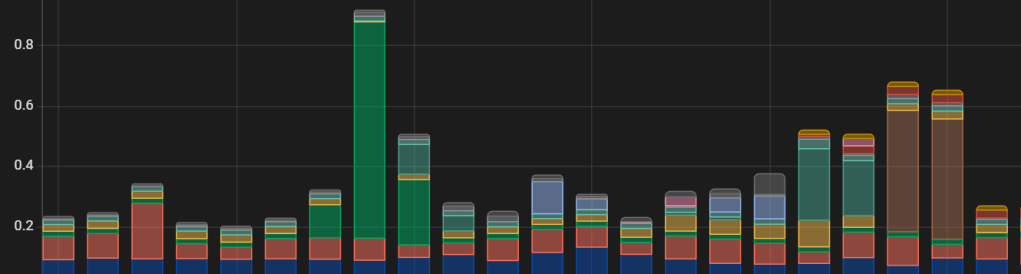
With per-circuit energy monitoring in place, the one-time tracking that I did in 2009 can now be done continuously. I now know, for example, that my Internet router, cable modem, Wi-Fi access points and low-power home media & automation server draw a continuous 40 watts – or about 30kwh/month. That’s a small number ($5 at current rates) – until I consider that my monthly electric usage in summer (pre-EV) was often under 300kwh/month.
Going forward I’ll now have the ability to monitor the energy use of my refrigerator, dishwasher, dryer and other large appliances; track the parasitic draw of all the small appliances that are left plugged in & running day & night; and of course track the energy used by the EV.
A short-term benefit is that the data will help me figure out if it pays to switch to a more efficient clothes dryer, clothes washer or refrigerator – all of which are now more than 20 years old. I’ll also be able to measure the impact of changes in our lifestyle.
 Michael Janke
Leave a comment