
We’re slowly working our way west again, this time towards Montana. The upper Missouri River basin is the target. We’ve been staying in various North Dakota State Parks for the last week, roughly tracking the Missouri River.
ND has nice parks.
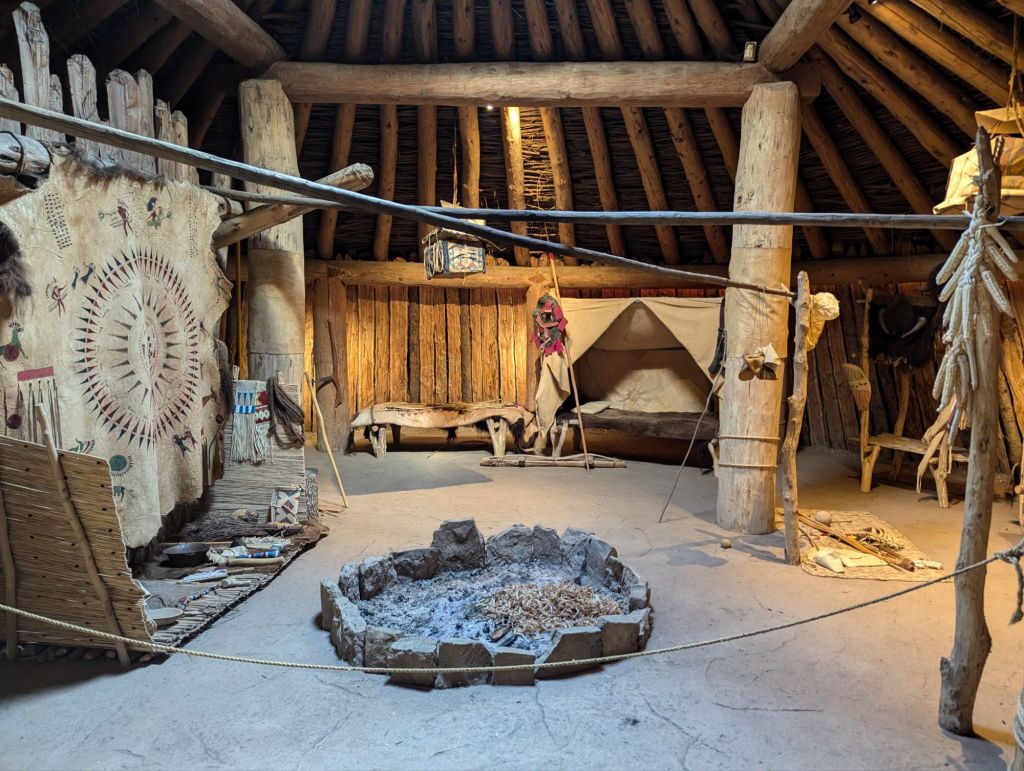
We visited the Knife River Indian Village National Historic Site, which preserves the remnants of a Mandan village. They lived in wood/earthen houses. Pretty comfortable compared to some of the early settlers accommodations.
We also spent time touring the Audubon National Wildlife Refuge near the Garrison Dam. A nice intersection of northern prairie and pothole wetlands.
The only adventure so far was a pretty decent thunderstorm that hit us the other night. Lightning frequent enough to keep the campground continuously lit, rain and hail dense enough to flood the campsites.
Of course this was all Native American territory prior to the invasion of Western Europeans. Now, not so much. In the northwest corner of the state though, is a unique tribal community called the ba-ken-frac-en-pum-pen. This tribe has taken over part of the state, having migrated from their native territory in Texas and Oklahoma. They are known for their environmental stewardship, egalitarian social structure, and their generosity when sharing their wealth with the less fortunate. The ba-ken-frac-en-pum-pen create ceremonial sites at intervals across the prairie, consisting of monolithic steel cylinders erected near large T-shaped structures. The “T” structures are unique in that the cross of the “T” rocks up and down to the rhythm of music only they can hear. There are many such ceremonial sites in this part of the state. Presumably to extract from the earth the offerings that facilitate the worship of their gods.
Drinking Water, Sans Plastic
In our various camping trips over the last decade-plus, we’ve relied on store-bought water for drinking & using the fresh tank for everything else. My theory has been that the water in the fresh tank isn’t really drinkable – even if we periodically sanitize the tank and plumbing, which I never do anyway. Purchased drinking water almost always tastes better than local water, and probably is less likely to be loaded with nitrites from local farms, as rural water supplies might be.
But we’re not fans of continuous exposure to plastics in what we eat and drink – I figure that the PFOAs & PFOS’s the local 3M chemical plant has saturated our groundwater with are more than enough to preserve my body longer than an Egyptian mummy, I’ve already been sufficiently exposed to benzine and trichloroethylene (sp?) from the time that I worked in machine shops, and my generation grew up during a period when near-continuous exposure to pesticides, herbicides and lead was guaranteed. No need to add microplastics and random polymers to that mess. And of course the obvious problem of realistically handling the plastic waste stream.
Eliminating plastic is challenging though. The water bottles that we use while hiking have to be either stainless steel or glass, the water containers that we use to store drinking water in the camper have to be glass, etc.
This trip we’re using ordinary backpacking style water filters to filter campground water, and storing the filtered water in half-gallon glass bottles. We’re using glass containers when hiking. I’m using a filter that has no charcoal element though, so we taste whatever is in the source water and probably are doing nothing to filter nitrites.

Kind of cumbersome though.
One solution would be to filter the water when filling the fresh tank, which assumes that the fresh tank is clean and that long term storage in polyethylene water tanks is OK. An alternative would be to install a permanent water filter under the sink and assume that it would filter the water from the fresh tank adequately. I’m not a fan of either, for various reasons.
We’ll play around with different filtering strategies and see if we find that works, without being too cumbersome.
Tonight we’re staying on the north side of Theodore Roosevelt National Park in the Juniper campground. Met a couple from Montreal with an identical campervan. They did some interesting modifications, one of which I might try someday.
 Michael Janke
Leave a comment