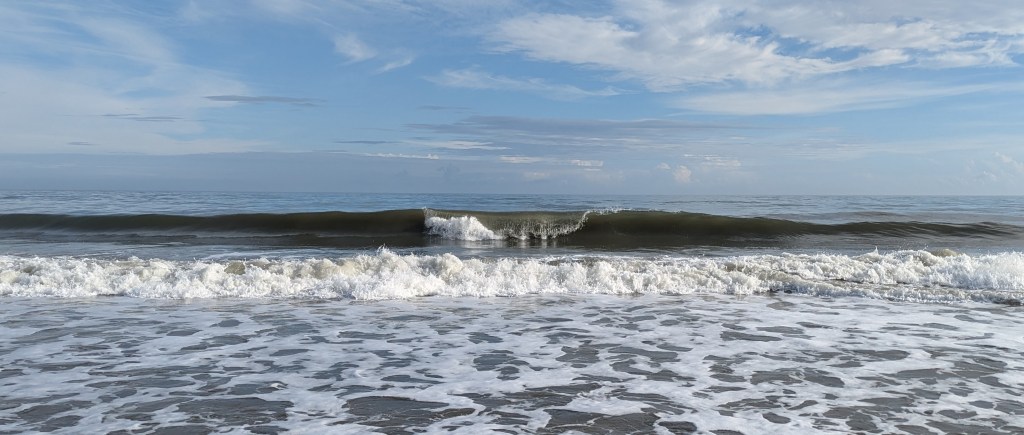
It would be a shame to cross half the country, camp within an hour-and-a-half of the ocean and not get our feet wet.
So we did.
Edisto Beach State Park, on the Atlantic south of Charleston, is on an ‘island’ of sorts, surrounded by salt marshes. It’s somewhat quiet in winter and out of the way at the end of a single road, twenty miles long.
The salt marshes fill and empty with the tides, attracting egrets, ibis and herons as they fill and drain. I was surprised at how far inland were the effects of the tides – the land here is extremely flat and barely above high tide. A storm surge wouldn’t have much to slow it down.
The Park has one campground a mile inland along a salt marsh, another on the beach – actually a spit of land between the ocean and a salt marsh. We ended up spending a couple days in each campground, both times in sites backed up against a marsh.

Nice views from the campsites.
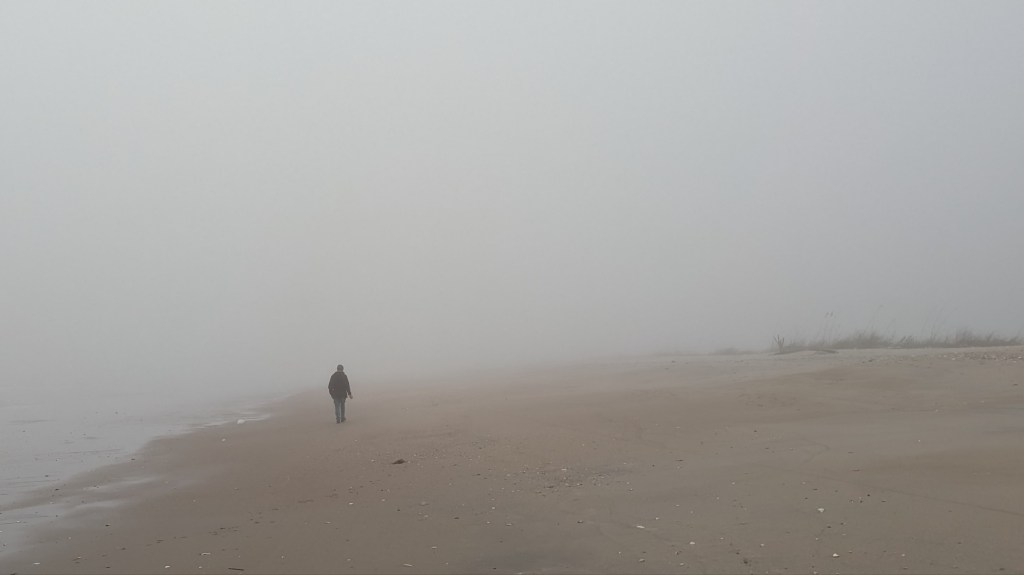
It was good to put our feet in the ocean again – we don’t get to do that very often in Minnesota.

The ocean was rough – I watched an entire village get consumed by the high tide.

Nearby is ACE Basin National Wildlife Refuge, part of which was formerly an antebellum plantation (The Grove Plantation).

The area was known for rice and cotton. Fields were created by clearing swamps and diking the local rivers, using slave labor, of course. Crops were planted and harvested using slave labor, of course. Much wealth was created, none of which went to the persons doing the hard work.
Near the end of the Civil War, the coastal rice and cottom plantations that had been abandoned by the disloyal plantation owners were ordered to be divided up and given to recently freed slaves (Union General Sherman’s Field Order 15). The idea that land previously owned by insurrectionists could be confiscated and given away didn’t sit well with the then-President Andrew Johnson, who believed that blacks had less “capacity for government than any other race of people” and that “whenever they have been left to their own devices they have shown a constant tendency towards barbarism”. So the (white) owners got their plantations back and the (black) freed slaves got evicted.
No free land for freed slaves.
Here is a link to more information on coastal and inland rice plantations. For an excellent study of the post-Civil War Reconstruction era, see Eric Foner’s “Reconstruction Updated Editon: America’s Unfinished Revolution“.
 Michael Janke
Leave a comment